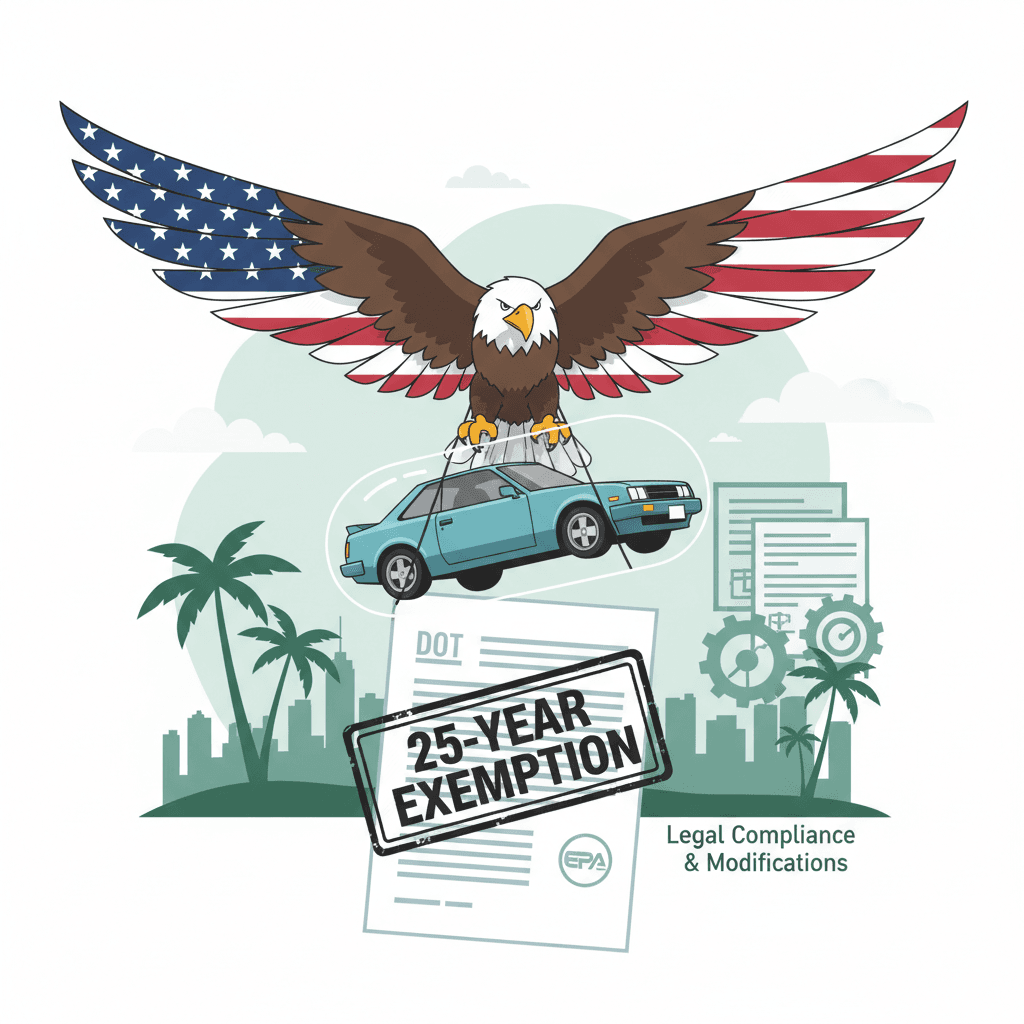
How can I import a right-hand-drive car into Florida? Short answer: you must follow federal DOT/EPA rules (unless the vehicle is 25 years or older), complete state-required modifications and inspections, and present clear documentation at title/registration.
Overview — why RHD imports need special attention
Importing right-hand-drive vehicles requires attention because the United States regulates vehicle safety, emissions, and equipment to protect drivers and other road users. RHD vehicles built for left-side driving countries can have headlight patterns, marker lights, speedometer units, and safety labels that differ from U.S. standards. RHD vehicles are subject to federal DOT/EPA rules unless the vehicle is 25 years or older (the 25-year rule). Florida may require specific modifications (lighting, speedometer) and documentation during titling/registration.
For example, a 2010 Nissan Skyline imported from Japan will often need headlight re-aiming or replacement and may need certification that the airbags and seat belts meet U.S. standards. South Florida buyers frequently import JDM sports cars and then work with local shops in Miami or West Palm Beach for conversions and inspections. These practical differences — not a single missing paper — determine whether a vehicle clears title and can be legally driven.
Who this is NOT for: If you need a guaranteed, quick resale vehicle or a short-term show car without registration, this process may be too slow and costly. If the car is unsafe without major structural repairs, don’t import it expecting simple modifications to fix fundamental issues.
Federal rules that affect RHD imports (DOT & EPA) and the 25-year exemption
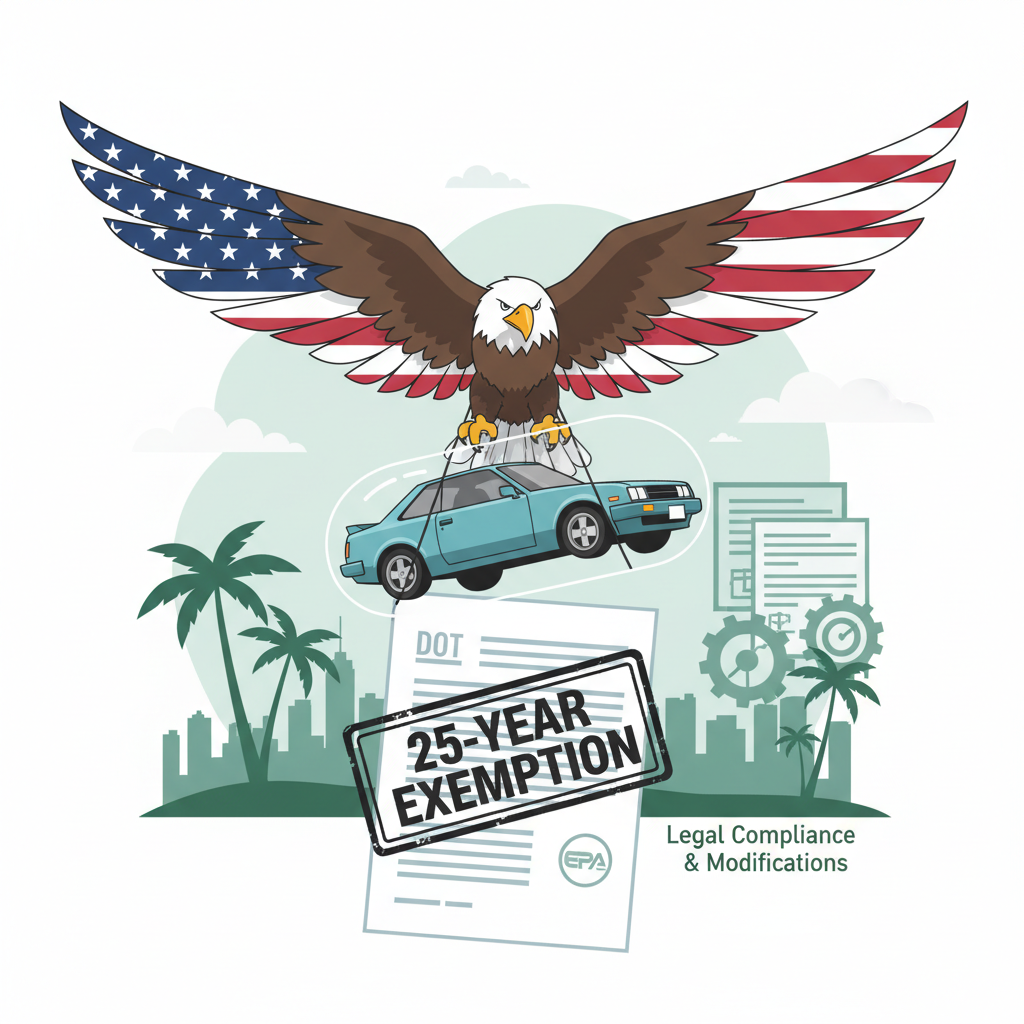
The Department of Transportation (NHTSA) and the Environmental Protection Agency (EPA) enforce safety and emissions standards for imported vehicles. If a car was not originally manufactured to meet U.S. FMVSS (Federal Motor Vehicle Safety Standards) and EPA emissions standards, it must be brought into compliance or qualify for the 25-year exemption. The 25-year rule means any vehicle 25 years or older is exempt from DOT/EPA compliance requirements and can be imported without the usual modifications and certifications required for newer cars.
Practical example: a 1996 Toyota Crown (imported in 2022) would typically qualify for the 25-year exemption and avoid costly DOT/EPA retrofits. But a 2010 model requires documentation proving conformity or a registered Registered Importer (RI) to perform modifications and provide a certification letter. For businesses and enthusiasts, the decision to import should start with a model-year check against the 25-year rule.
RHD vehicles younger than 25 years require DOT or EPA compliance letters before Florida will title them.

Quotable: "The 25-year rule exempts older vehicles from DOT/EPA retrofit requirements."
Florida-specific steps: inspections, lighting, and required modifications
Florida requires a title, registration, and a vehicle identification check at the time of titling. For RHD imports, the state inspects exterior lighting, turn signals, and safety equipment to confirm they meet Florida statutes. Expect examiners to verify that headlights are aimed and patterned for driving on the right side of the road and that exterior marker lights and reflectors are compliant.
Florida's titling office will review submitted DOT/EPA paperwork (or evidence of 25-year exemption) and look for proof that required modifications were completed by a qualified shop. If the vehicle retains original foreign equipment that prevents safe operation on U.S. roads — for example, left-side headlamp beams that dazzle drivers — the state may refuse registration until the issue is fixed.
Headlight pattern and speedometer readout are the two most common reasons Florida examiners hold registration.
Headlight alignment, speedometer conversion, safety labeling
Headlights on RHD cars produce a beam aimed for left-side driving; to avoid blinding oncoming traffic the beam must be re-cut, replaced, or adjusted to a right-side driving pattern. Options include fitting U.S.-spec headlamps, installing beam converters (where allowed), or re-lensing where feasible. Expect a local shop in Miami or West Palm Beach to charge for parts and labor and to provide before/after photos.
Speedometer conversion often means changing from kilometers-per-hour to miles-per-hour or fitting an electronic recalibration module. Some vehicles require replacement gauges; others accept a discreet conversion unit. Safety labeling — VIN plates, tire placards, and airbag labels — must be legible and in English. If original labels are missing, shops can install compliant replacement labels and provide a statement of conformity.
Seat belt and airbag compliance considerations
Seat belt anchors, pretensioners, and airbags are subject to FMVSS standards. If the vehicle’s restraint systems differ significantly from U.S. configurations (for example, different pretensioner types or seat-belt latch geometry), a certified shop or Registered Importer should evaluate whether components can be retrofitted. Replacing entire seat assemblies is sometimes required when mounting points or pretensioner systems are incompatible.
Airbag compatibility is sensitive: disconnecting or altering airbags incorrectly can create serious safety hazards and violate federal rules. Always use experienced technicians for airbag work and request written descriptions of repairs and serial numbers of replacement modules when applicable. Florida titling officers commonly ask for proof that restraint systems function and meet applicable standards.
Step-by-step checklist for bringing an RHD vehicle into compliance in Florida
- Confirm model year and check the 25-year rule.
- Collect original title, export documents, and vendor receipts from the seller.
- Determine necessary DOT/EPA paperwork or 25-year exemption evidence.
- Arrange needed mechanical modifications: headlights, speedometer, marker lights, safety labeling.
- Have a certified inspection completed; collect written statements and before/after photos.
- Present documentation to Florida DMV for title and registration.
- Keep all receipts, compliance statements, and shop certifications for resale or audit.
Use this numbered checklist to track progress; each item is a required gate for successful titling.
Where to get modification and inspection work done in South Florida (examples & questions to ask service providers)
South Florida has specialty shops experienced with RHD imports, particularly in Miami and West Palm Beach. Look for shops that list experience with Japanese Domestic Market (JDM) or UK imports, and ask questions before you book work. Sample questions: Do you have experience converting headlights for RHD cars? Can you recalibrate or replace the speedometer for MPH? Do you provide a written compliance statement and before/after photos?
When contacting a shop, request references for similar projects and confirm technician certifications for airbag and seat-belt work. Ask for a scope document with estimated parts and labor and a timeline. Demand a final compliance letter that explicitly states which U.S. standards the shop addressed — that letter is often required at Florida title time. South Florida shops familiar with the process can reduce surprises and speed up registration.
Documentation to present at title/registration (proof of modifications, compliance statements)
At titling, Florida DMV typically expects: original out-of-country title, bill of sale, bill of lading or CBP entry documents, DOT/EPA certification or 25-year exemption proof, and written statements from shops listing modifications performed. Useful attachments include before/after photos, headlamp replacement invoices, speedometer conversion receipts, and any Registered Importer letters if applicable.
Provide one consolidated packet: index page, original title, export/import papers, shop compliance statements, and mechanic receipts. If the vehicle required emissions work, include an emissions compliance statement. Florida examiners appreciate clear, labeled documentation; it reduces processing time and the chance of follow-up requests.
Cost ranges & timeline estimates for common conversions
Costs vary by vehicle and parts availability. Typical South Florida cost ranges and timing (examples):
| Conversion | Estimated cost | Typical completion time |
|---|---|---|
| Headlight conversion or replacement | $150–$800 | 1–3 days |
| Speedometer recalibration or replacement | $100–$600 | 1–3 days |
| Safety labeling and minor wiring | $50–$250 | Same day |
| Seat/airbag retrofit (if needed) | $500–$2,000+ | 2–7 days |
These estimates are examples based on common South Florida shop pricing; parts scarcity or complex airbag systems will drive costs higher. Always get written estimates and expected completion dates.
Case studies: successful RHD imports in Florida (short examples)
Case 1 — JDM coupe: A buyer imported a 1998 Nissan with original title and export docs, qualified under the 25-year rule, paid local shop $220 for headlamp adjustments, and titled the car in Miami within two weeks. Case 2 — newer RHD hatchback: A 2012 model required headlight replacement, speedometer module, and a Registered Importer conformity letter; total outlay was around $1,800 and the process took six weeks from arrival to registration.
These short examples show the key decision points: check the 25-year rule first, then estimate modifications. For southfloridaimports.com readers, documenting each step (photos + invoices) proved decisive in reducing DMV follow-ups.
FAQs and quick decision guidance (buy vs modify vs reship)
What does it mean to import right? Importing right in this context means bringing a right-hand-drive vehicle into Florida and completing the federal and state compliance steps required to legally title and operate it on U.S. roads.
How do you import right? You import a right-hand-drive vehicle by confirming model year (25-year rule), obtaining proper export/import paperwork, completing any required DOT/EPA retrofits, having Florida-compliant modifications done, and presenting documentation at the DMV for title and registration.
Quick decision guidance: If the vehicle is under 25 years and requires multiple major safety retrofits, consider reshipping or selling overseas. If it’s older than 25 years or only needs simple lamp and label work, modification and local titling is usually cost-effective.
Action checklist and local service recommendations
Final action checklist:
- Verify the model year and 25-year rule.
- Gather export/import and title documents before shipping.
- Request written scopes and estimates from South Florida conversion shops (Miami, West Palm Beach).
- Obtain signed compliance statements and before/after photos for the DMV packet.
- Schedule DMV appointment with organized documentation.
For southfloridaimports.com readers: ask local shops for sample compliance letters and sample invoices from prior RHD projects. Keep all records; they’re the single best defense against registration delays. Final note: import right-hand-drive car florida remains manageable when you plan for DOT/EPA checks, state inspection work, and clear paperwork.