TL;DR
- Quick answer: importing a car to Florida typically adds shipping, customs duty, EPA/DOT compliance costs, state sales tax and registration; many buyers use specialized lenders or broker financing to cover those upfront fees.
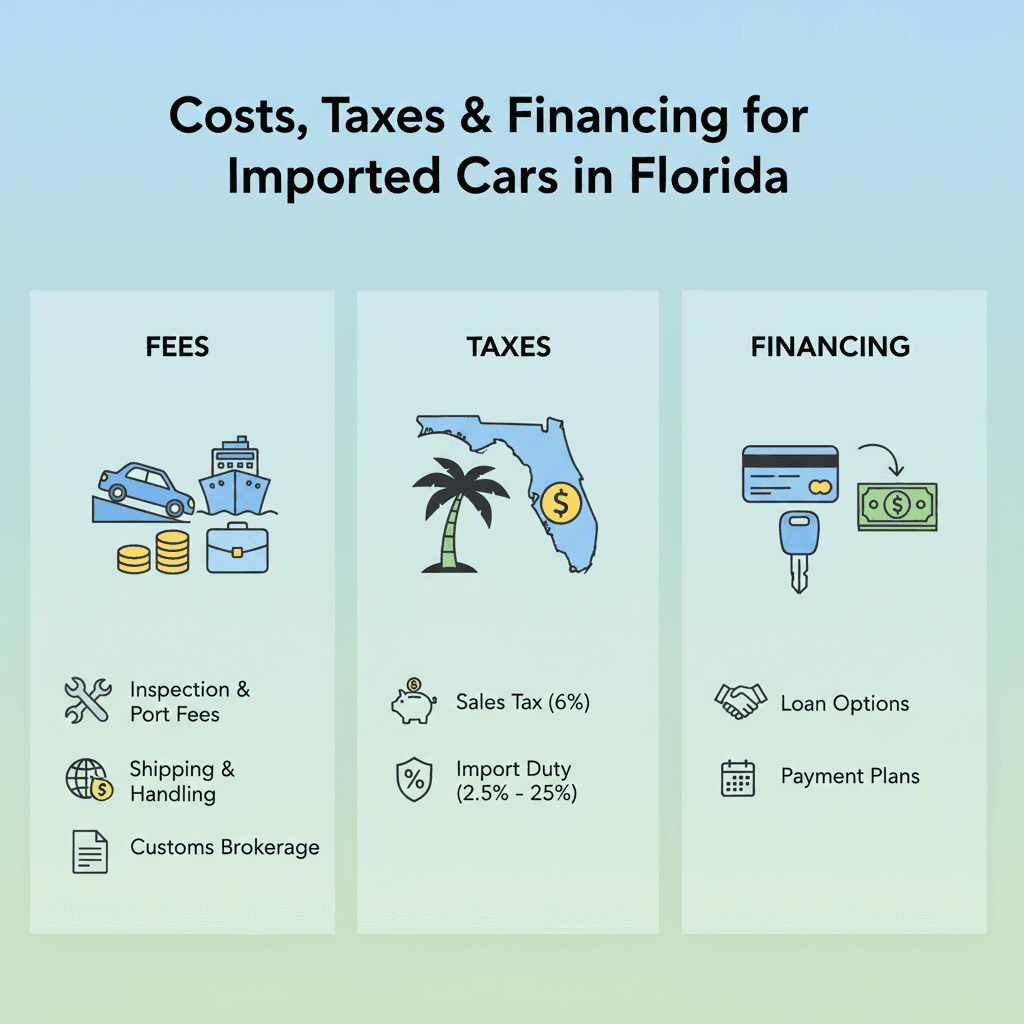
- Tax note: Florida imposes state sales tax (6%) plus county discretionary surtaxes; total tax depends on the purchaser's county of residence—verify with county tax collector. Duties depend on the vehicle's country of origin and HS code; consult CBP's Harmonized Tariff Schedule.
- Get written quotes from a carrier, a licensed customs broker, and a compliance shop before finalizing purchase. Use the three sample cost tables below to approximate low, mid, and high-end scenarios.


Overview — which costs to expect when importing to Florida
Problem: you found the exact car overseas, but the sticker price ignores the true cost to import a car to Florida. That apparent bargain can vanish once you add ocean freight, port handling, U.S. customs duty, EPA/DOT modifications, Florida sales tax, registration, and last-mile transport. The solution is to budget every line item before purchase and to consider import car financing florida options that cover both vehicle price and import-related fees.
Start by listing the purchase price, an estimated shipping quote, customs duty estimate (based on HS code), EPA/DOT compliance estimate, and Florida import car taxes and registration. A conservative early budget rule: add 15–30% to the overseas purchase price for low-to-mid vehicles, and 30%+ for collector or compliance-heavy cars.
Quotable: "Budget 15–30% of the purchase price for realistic import costs on most cars."
Actionable first steps:
- Request an itemized pro forma invoice from the seller that shows FOB or CIF terms.
- Ask two shippers for roll-on/roll-off and container quotes to compare risks and prices.
- Contact a licensed customs broker in Florida for a duty estimate based on the vehicle's make, model year, and country of origin.
When this guide doesn't apply (who this is NOT for)
Do not follow these detailed import steps if any of the following apply:
- You are buying from a U.S. dealer already titled in Florida — domestic purchase rules apply.
- The vehicle is coming from a U.S. territory with special tax rules (Puerto Rico or U.S. Virgin Islands) — consult local rules first.
- The car is noncompliant and you plan to export it again immediately — import taxes may still apply.
Shipping and handling fees (international freight, port fees)
Why this matters: shipping and handling are the first unavoidable costs after the purchase price, and they vary widely by port pair, shipping method, and containment choice. If you skip accurate shipping quotes, the next stages (duties, compliance) will be under-budgeted and financing gaps will appear.
Typical shipping charges include: ocean freight (roll-on/roll-off or container), origin port handling (terminal handling charges), destination port fees (including unloading and container administration), customs broker entry fees, and inland transport to your garage. Expect additional charges for insurance (cargo insurance), phytosanitary inspections for certain vehicles, and storage if paperwork delays occur.
Example line items you should request from a shipper and broker (step-by-step):
- Obtain the shipper quote showing freight terms (FOB or CIF). If CIF, insurance and freight to the U.S. port are included; FOB leaves insurance to you.
- Ask the shipper for the expected vessel arrival date and estimated port charges at the destination port (e.g., Port of Miami, Port Everglades).
- Ask a licensed customs broker for an estimate of entry fees, ISF filing, and estimated duty based on the vehicle VIN and build year.
- Include inland transport from the destination port to the inspection/compliance shop or your address.
Costs: for mainstream passenger cars, container shipping from Europe typically runs higher than RoRo from Japan. A conservative ballpark: $1,000–$3,500 for overseas ocean freight and terminal handling to a South Florida port, with additional $200–$800 for inland transport and broker fees. High-value vehicles shipped in dedicated containers often cost $3,000–$8,000.
Quotable: "Ask for a fully itemized shipping quote—FOB vs. CIF changes who pays for insurance and can save you thousands."
Typical ranges by origin (Europe, Asia, Caribbean)
Shipping costs vary by origin and routing. Typical ranges (conservative):
- Europe to South Florida (container preferred for high-value cars): $2,000–$6,000 depending on container type and port congestion.
- Asia (Japan, South Korea) to South Florida (RoRo common): $1,200–$4,000 depending on RoRo vs. container.
- Caribbean (short sea, island sources): $400–$1,200 for short-haul RoRo or ferry transfer to mainland hubs.
Real-world example: a 2010 BMW shipped from Hamburg to Port Everglades in a shared container might cost $2,800 freight + $450 origin terminal + $600 destination terminal + $300 inland trucking = roughly $4,150 before insurance and broker fees.
U.S. Customs duties and tariff basics
Why this matters: duties are assessed at import and are usually payable before the carrier releases the vehicle. Underestimating duties leads to release delays and surprise bills the broker will demand you pay on short notice.
Rules summary: U.S. customs duty for passenger vehicles is usually calculated as a percentage of the vehicle's declared value or the transaction value on the bill of sale. The duty depends on the vehicle type and country of origin (some countries enjoy preferential rates under trade agreements). Classic metrics for customs clearance include the bill of sale, bill of lading, manufacturer's certificate of origin (if new), and proof of insurance.
Actionable steps:
- Provide your customs broker with the seller's invoice, the VIN, and the transport documents to obtain a preliminary duty estimate.
- Confirm the vehicle's country of origin and whether any tariff exceptions apply.
- Budget for broker fees and possible duties—don’t assume duty is zero unless you have documentation supporting an exemption.
Quotable: "Duties are calculated on the declared transaction value and hinge on the vehicle’s HS code and country of origin."
How to determine HS codes and duty rates
HS codes (Harmonized System codes) categorize goods for tariffs. For vehicles, HS headings differentiate passenger vehicles, trucks, and special-purpose vehicles. To find the correct HS code and duty rate:
- Note the vehicle type, engine displacement, and model year.
- Ask your customs broker to propose the HS code; brokers have access to CBP tariff lookups and experience with vehicle classifications.
- Verify the proposed rate in the U.S. Harmonized Tariff Schedule (HTS) by consulting CBP resources or asking the broker to provide the exact HTS subheading and corresponding duty percentage.
Example: many passenger cars face duties in the 2.5%–25% range depending on classification and trade rules; collectible or racing vehicles can have different treatments. Always get a written duty estimate from the broker and record the HTS number used to calculate it.
Classifying a vehicle under the wrong HS code can increase duty and delay release; verify HTS numbers with a customs broker before shipment.
EPA/DOT compliance modification costs
Why this matters: imported cars must meet U.S. Environmental Protection Agency (EPA) and Department of Transportation (DOT) standards. Noncompliant vehicles may be refused entry or held until certified modifications are made. These costs can exceed $5,000 for engine or emissions conversions on certain models.
Typical compliance costs include emissions retrofits, speedometer adjustments (miles vs kilometers), lighting changes, seat belt modifications, and the filing fees for EPA/DOT conformity documentation. For used cars legally certified in their origin country, costs are often limited to paperwork and minor modifications. For left-hand drive vs. right-hand drive issues or vehicles not originally built to U.S. specs, expect higher modification bills.
Step-by-step approach to estimate EPA/DOT costs:
- Request the vehicle’s build sheet and emissions certification from the seller.
- Contact an EPA-compliance shop in South Florida with the VIN and build details for a written quote.
- If substantial work is needed, ask for an itemized quote and a timeline; longer repairs create storage and transport costs.
Example: a Euro-spec diesel requiring particulate filter changes and ECU mapping might cost $3,000–$7,000 to meet EPA standards. A Japanese domestic-market vehicle (JDM) may need headlamp and seatbelt adjustments costing $800–$2,500.
Florida sales tax & registration fees
Why this matters: Florida import car taxes and registration fees are paid when you title and register the vehicle in the state. Failure to budget these results in immediate out-of-pocket costs at the county tax collector when you try to title the vehicle.
Key items to budget for:
- State sales tax (base 6% on the purchase price or declared value)
- County discretionary surtax (varies by county; can add 0.5%–1.5% or more)
- Title fee, registration fee, and initial license plate fees (flat amounts set by FLHSMV)
Tax note: Florida imposes state sales tax (6%) plus county discretionary surtaxes; total tax depends on the purchaser's county of residence—verify with county tax collector. Duties depend on the vehicle's country of origin and HS code; consult CBP's Harmonized Tariff Schedule.
Practical steps to calculate total local tax:
- Use the seller’s invoice value or the U.S. customs appraised value as the taxable base for state sales tax calculations.
- Call your county tax collector for the current discretionary surtax rate and title fees.
- Bring customs entry docs (CBP Form 7501), bill of sale, and proof of identity to the county office when titling.
How county discretionary surtaxes affect total tax
County surtaxes vary: for example, one county might charge an additional 0.5% while another charges 1%. That difference on a $50,000 declared value changes your tax by $250–$500. Always compute the total sales tax by adding Florida’s 6% base plus your county rate to produce an accurate total before financing.
Example calculation: $30,000 declared value x 6% = $1,800 state tax. If your county has a 1% surtax, add $300 for total sales tax of $2,100. Then add title and registration fees—often $225–$400 combined depending on plate type and initial registration year fees.
Import-related inspections and repair estimates
Why this matters: before you can title the car in Florida, county or state inspectors may require condition reports, VIN verification, and emissions tests for certain vehicles. Inspections catch hidden damage, noncompliance items, and mechanical issues that overseas sellers omit.
Typical inspection and repair scopes include VIN verification, brake and suspension checks, emissions testing, safety item replacement (lights, mirrors), and addressing any rust or structural concerns. Budget for a pre-purchase inspection (PPI) performed either in the origin country or immediately upon arrival; a PPI can save thousands by identifying costly repairs early.
Estimate ranges: a local inspection runs $150–$350. Small repairs like lights or seals are $200–$1,000. Major mechanical repairs or rust remediation can be $2,000–$10,000 depending on severity.
Actionable checklist for inspections:
- Order a PPI from a trusted South Florida inspector if the seller can’t provide a reputable local inspection.
- Require photos of undercarriage and engine bay with timestamps from the seller when possible.
- Include an allowance in your budget for at least one round of post-arrival repairs—$500 minimum for used imports, $2,000 budgeted for older or high-mileage cars.
Financing options for imported vehicles
Why this matters: not every lender will finance an imported vehicle, and loans that do finance them often require more paperwork, a higher down payment, or a short lien period until compliance and titled status are confirmed. Knowing your finance options prevents payment surprises and helps you close the deal quickly.
Main financing routes:
- Specialty lenders that underwrite imported vehicles and collectible cars.
- Traditional banks and credit unions that will finance only once the vehicle is titled in the borrower’s name in Florida.
- Dealer financing if you acquire the vehicle through a licensed dealer that handles imports and titles.
- Personal loans or home equity lines for buyers who cannot secure vehicle loans before title issuance.
Key financing considerations for import car financing florida:
- Many lenders require the vehicle to be U.S.-compliant and titled before final loan funding.
- Some lenders will advance funds to cover purchase and shipping if you provide a detailed compliance plan and broker commitments.
- Expect higher interest rates or lower LTV (loan-to-value) ratios for vehicles with uncertain resale or nonstandard configurations.
Always confirm whether your lender requires U.S. title and insurance before funding—some lenders will not advance money until the vehicle is already titled.
Lenders that finance imports, required paperwork, and appraisal tips
Practical guidance when securing a lender to finance imported car in Florida:
- Identify specialty lenders or credit unions with experience in imported or collector vehicles; ask for their import underwriting checklist.
- Prepare paperwork: purchase invoice, bill of lading, customs entry (CBP Form 7501), compliance receipts, and the vehicle appraisal (if required).
- Get a professional appraisal: lenders typically accept appraisals from ASE-certified appraisers or recognized collector-car appraisal services. Appraisals should include VIN, odometer reading, condition notes, and comparable sales.
Example lender requirement: a specialty auto lender might require a 20% down payment on a noncompliant vehicle and provide conditional funding contingent on completion of EPA/DOT modifications and issuance of Florida title within 90 days.
Quotable: "If you plan to finance imported vehicles, secure lender pre-approval and confirm their conditions about title and compliance up front."
Cost comparison: importing vs buying domestically in Florida
Why this matters: the decision to import should be based on a total-cost comparison, not just purchase price. Importing can make sense for rare models not sold in the U.S., but for mass-market cars the cumulative import costs often eliminate any savings.
Comparison factors:
- Availability: If the model is common in Florida, dealer warranties and easier financing often offset a slightly higher sticker price.
- Upfront cost vs. long-term value: imported classics or performance models might appreciate; mainstream imports rarely appreciate more than domestic equivalents.
- Time-to-use: domestic buying usually delivers immediate use whereas imports can take weeks to months with paperwork and compliance.
Example calculation approach: add purchase price + estimated shipping + estimated duties + EPA/DOT compliance + Florida import car taxes + registration + inspection and repairs. Compare that total to a clean, similar domestic vehicle including warranty and dealer financing terms. If the imported total exceeds the domestic total by less than the value you place on model uniqueness, importing may still be worthwhile.
Practical examples and sample cost breakdowns (3 scenarios: low-cost import, mid-range, high-end collector car)
Below are conservative sample cost tables. Use these to sanity-check quotes. Get firm numbers from shippers and brokers before committing.
| Line item | Low-cost import | Mid-range import | High-end collector |
|---|---|---|---|
| Purchase price | $8,000 | $25,000 | $120,000 |
| Shipping & port fees | $1,200 | $3,500 | $5,500 |
| Import duties (estimate) | $200 | $1,000 | $6,000 |
| EPA/DOT compliance | $500 | $1,500 | $7,000 |
| Registration & title | $300 | $400 | $400 |
| Local sales tax (6% + county) | $540 | $1,650 | $7,920 |
| Transport & inspection | $300 | $600 | $1,000 |
| Estimated total | $11,040 | $34,150 | $147,820 |
Notes: these are illustrative. Duty is vehicle-specific and HS code–dependent. High-end collectors often require enclosed container shipping and secure handling, which increases freight and insurance.
How to budget to avoid surprises and helpful financing calculators
Why this matters: budgeting prevents last-minute cash calls from brokers and shippers. Lenders may not fund until a vehicle meets compliance and is titled, so you may need bridging funds to cover shipping, duty, and modifications.
Step-by-step budget checklist:
- Step 1: Obtain seller invoice and VIN; request at least two shipping quotes with estimated arrival dates.
- Step 2: Ask a customs broker for an HTS-based duty estimate and entry fee quote.
- Step 3: Get an EPA/DOT compliance estimate from a certified compliance shop using the VIN and build sheet.
- Step 4: Estimate Florida import car taxes using the invoice value and your county’s surtax rate.
- Step 5: Add contingency: +10–20% of the subtotal for unexpected repairs, demurrage, or delays.
Use simple calculators: add purchase price + shipping + duty + compliance + taxes + inspections + contingency to get a required funds total. Then compare to lender pre-approval amount and identify any shortfall to be covered by cash or bridge financing.
How our product helps (integrate checklists, document automation, vendor directories)
This platform streamlines the import workflow by integrating three capabilities you need: checklists, document automation, and vendor directories. The checklist ensures you ask sellers and shippers for the exact documents customs and the county will require. Document automation produces a single packet (invoice, bill of lading, power of attorney, compliance quotes) that you can share with brokers and lenders. The vendor directory connects you to vetted South Florida brokers, compliance shops, and transporters to get multiple quotes quickly.
Example workflow using the product (step-by-step):
- Create a project and upload the overseas invoice and VIN.
- Run the automated checklist to request shipping and compliance quotes from recommended vendors.
- Compile the broker duty estimate and compliance quote into a funding packet for lenders.
Actionable benefit: using a consistent packet reduces lender friction—appraisal and customs documentation arrive faster, which can shorten the funding timeline and reduce demurrage fees at the port.
FAQ
What is costs, taxes & financing for imported cars in florida?
Costs, taxes & financing for imported cars in Florida refers to the combined expenses and funding options involved in bringing a vehicle into Florida, including shipping, customs duties, EPA/DOT compliance, Florida sales tax and registration, inspections, repairs, and lender or broker financing arrangements.
How does costs, taxes & financing for imported cars in florida work?
The process works by first purchasing the vehicle, then arranging international shipping and customs entry, paying duties and port fees, completing EPA/DOT modifications if required, titling and registering the vehicle in Florida while paying state and county taxes, and finally securing financing either before or after title depending on the lender's requirements.
Further reading and recommended verification: consult U.S. Customs and Border Protection for HTS and duty calculators, check FLHSMV for current title and registration fees, and contact your county tax collector for discretionary surtax rates.